Oct 2026Research
The allocationquestion
A $300bn advisory firm now puts crypto at 10-40% of a portfolio. The number is arguable; the fact that it is being argued at all is the development.
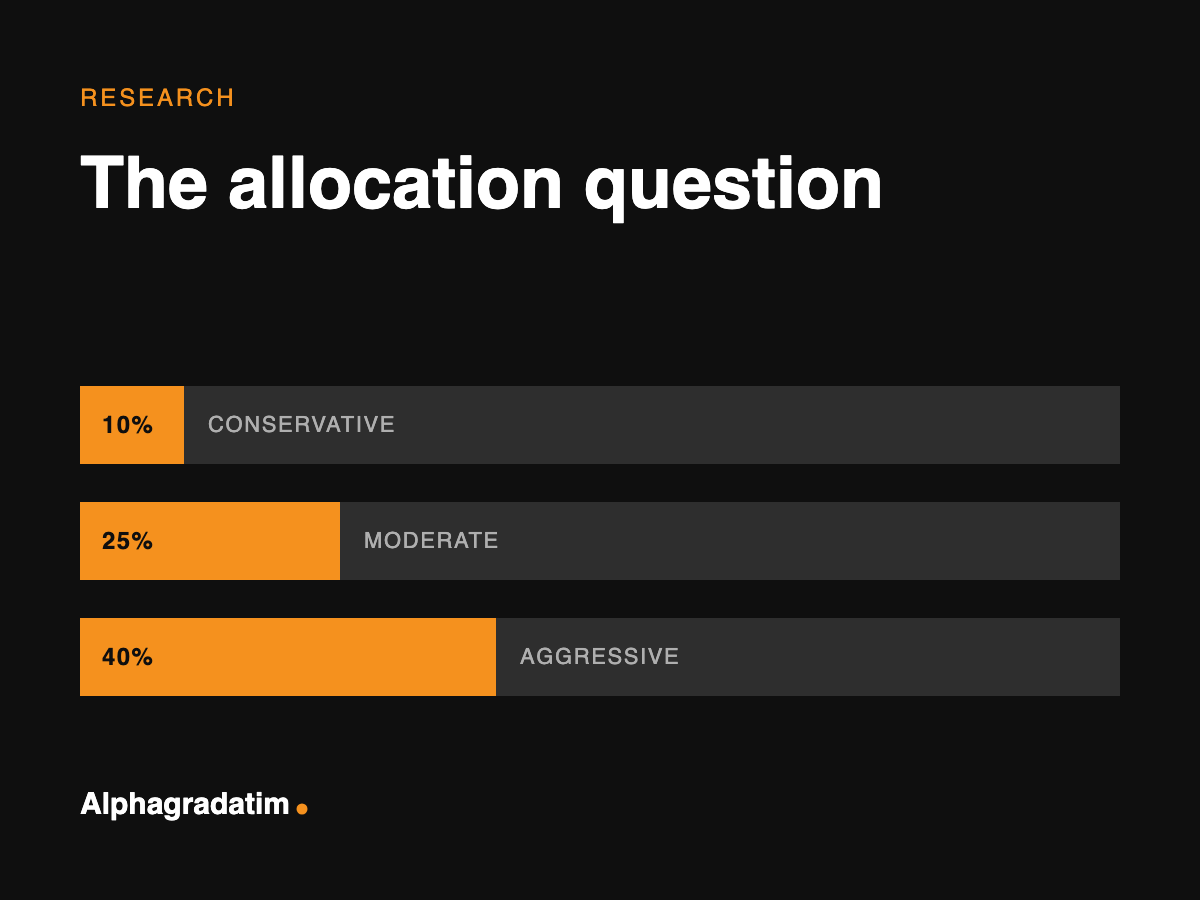
Ric Edelman — whose firm, Edelman Financial Engines, oversees roughly $300bn — has been recommending crypto allocations of 10% for conservative investors, 25% for moderate, and 40% for aggressive. A few years ago the same adviser suggested 1%. That is a forty-fold revision from someone with no particular history as a digital-asset advocate, and it has been picked up widely enough to function as a marker of where mainstream advice now sits.
The reasoning he gives is worth separating from the number. Two strands run through it: regulatory clarity and institutional participation have both improved materially, and longevity assumptions have shifted — a client expected to live past 100 has a different horizon, and therefore a different tolerance for an asset that is volatile over years but not necessarily over decades. He has also argued the traditional stock-bond frame should become stocks, crypto, and bonds, with bonds capped around 30%.
Take the argument at its strongest and it still runs into a sizing problem. A 40% allocation to an asset that has repeatedly drawn down more than 70% implies a portfolio-level loss of roughly 28% from that sleeve alone, before anything else in the book moves. Whether that is survivable is not a question about Bitcoin. It is a question about the holder — their liabilities, their reporting cycle, and whether anyone will force them to sell at the bottom.
That is why the interesting number is rarely the recommended one. Most institutional allocations that have actually been made sit far below these figures, usually in the low single digits, and they are sized against a drawdown the allocator has already decided they could sit through. The gap between 1-3% and 10-40% is not a disagreement about the asset. It is a disagreement about who the portfolio belongs to and what happens to the person running it during a bad year.
The second strand — that not owning it is now the speculative position — is the sharper claim, and the harder one to test. It rests on the view that the asset has crossed from optional to structural, in the way that equities did for institutional portfolios over the twentieth century. That may prove right. It is not currently demonstrable, and an argument that cannot be falsified within the holding period is a belief rather than a finding.
What can be said with more confidence is narrower. The operational obstacles that kept regulated money out — custody, audit, settlement, reporting — have largely been solved, which is why the conversation has moved from whether to hold the asset to how much. That shift is real and it is recent. It says nothing about the right weight, and it does not remove the volatility that makes the weight difficult.
The honest position is that the allocation question has no universal answer, and that any number offered as one should be treated with suspicion whatever its direction. The useful output of this debate is not a percentage. It is that allocators now have to state the drawdown they can actually sit through — which is a harder question than the weight, and the one the weight should follow from.
Partner with us
We work with a select group of investors who value access, transparency and individual attention. If you would like to understand the fund or the thinking behind it, we welcome a confidential conversation.